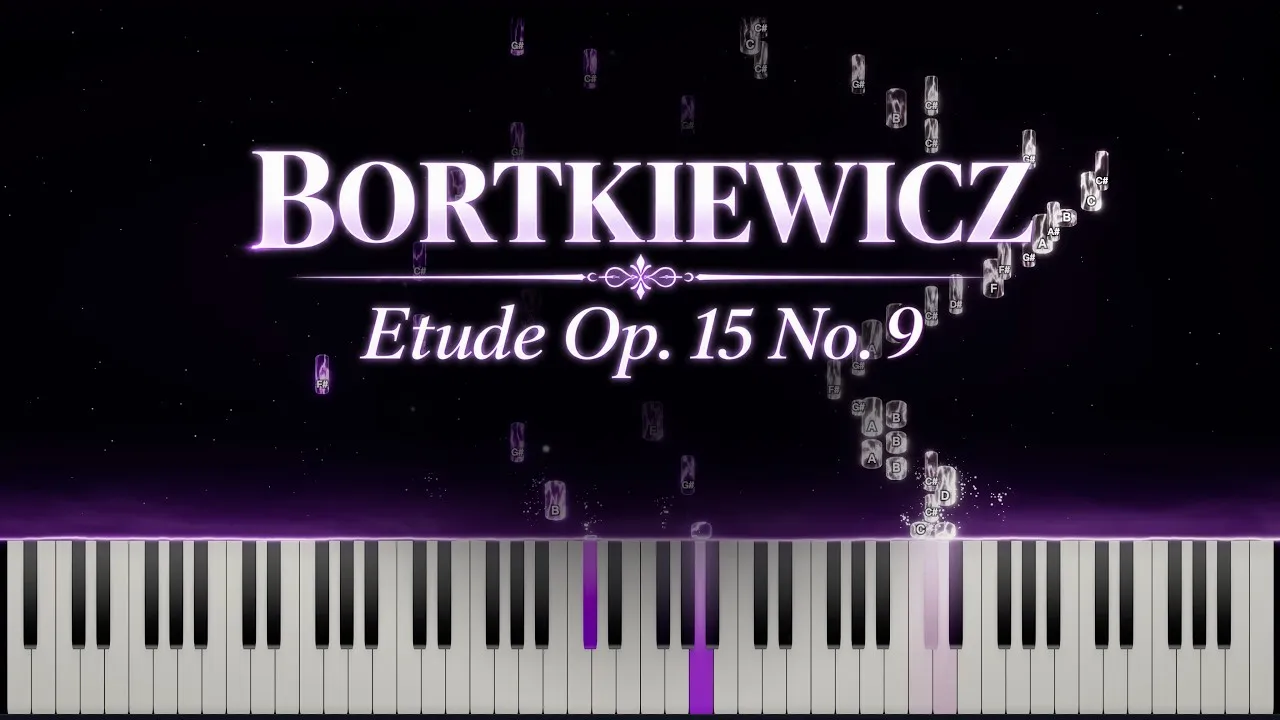
Bortkiewicz: Etude Op. 15 No. 9
Full falling-notes piano tutorial for Bortkiewicz's Etude Op. 15 No. 9 in F-sharp minor, from the ten etudes published in Leipzig in 1911.
About the piece.
The ten Etudes Op. 15 were published by D. Rahter in Leipzig in 1911, while Bortkiewicz was living in Berlin. He dedicated the set to the memory of his teacher Alfred Reisenauer, a pupil of Liszt, and the writing shows where he came from: these are concert etudes in the Romantic sense, where the technical problem is always carried by a melody.
No. 9 is in F-sharp minor and marked Allegro di molto. It is 70 bars long and takes a little under two minutes. The form is a simple ABA with a coda. The fast opening section comes first, its second phrase starting in C-sharp minor. The middle section hides a slower, singing line inside the figuration and briefly brings the opening back in B-flat minor. Then the opening returns, builds to the biggest climax of the piece, and the coda closes it.
Pianists describe it as Lisztian in its demands, with modulations that sound like Rachmaninoff. Denis Zhdanov, who teaches the piece, recommends it to late intermediate and advanced students because it covers many typical Romantic patterns in a short space, and because it makes a good encore. The Japanese pianist Kazurou Ooi adds a useful practice note: the tempo should stay flexible, not metronomic, and the piece still works below full speed.
Its neighbour in the set, No. 8 in D-flat major, was recorded by Moriz Rosenthal, an early champion of Bortkiewicz. No. 9 has been recorded by Cyprien Katsaris, Romain Nosbaum and Denis Zhdanov, among others.
- Composer
- Sergei Bortkiewicz
- From
- 10 Etudes, Op. 15
- Year
- 1911
- Key
- F-sharp minor
- Difficulty
- Advanced
- Length
- 1:45
- Sheet music
- IMSLP
Learn it at your own speed.
This tutorial was made with LumaKeys, a Mac app for learning piano from falling notes. Open a MIDI file of the piece, or transcribe a piano recording you have, then slow it down, loop the hard bars and practise one hand at a time. The download is free.
Your whole piano life in one app.
macOS 12 or later · On an Intel version?
Pro is $69 for a limited time, then $99. See what Pro adds.