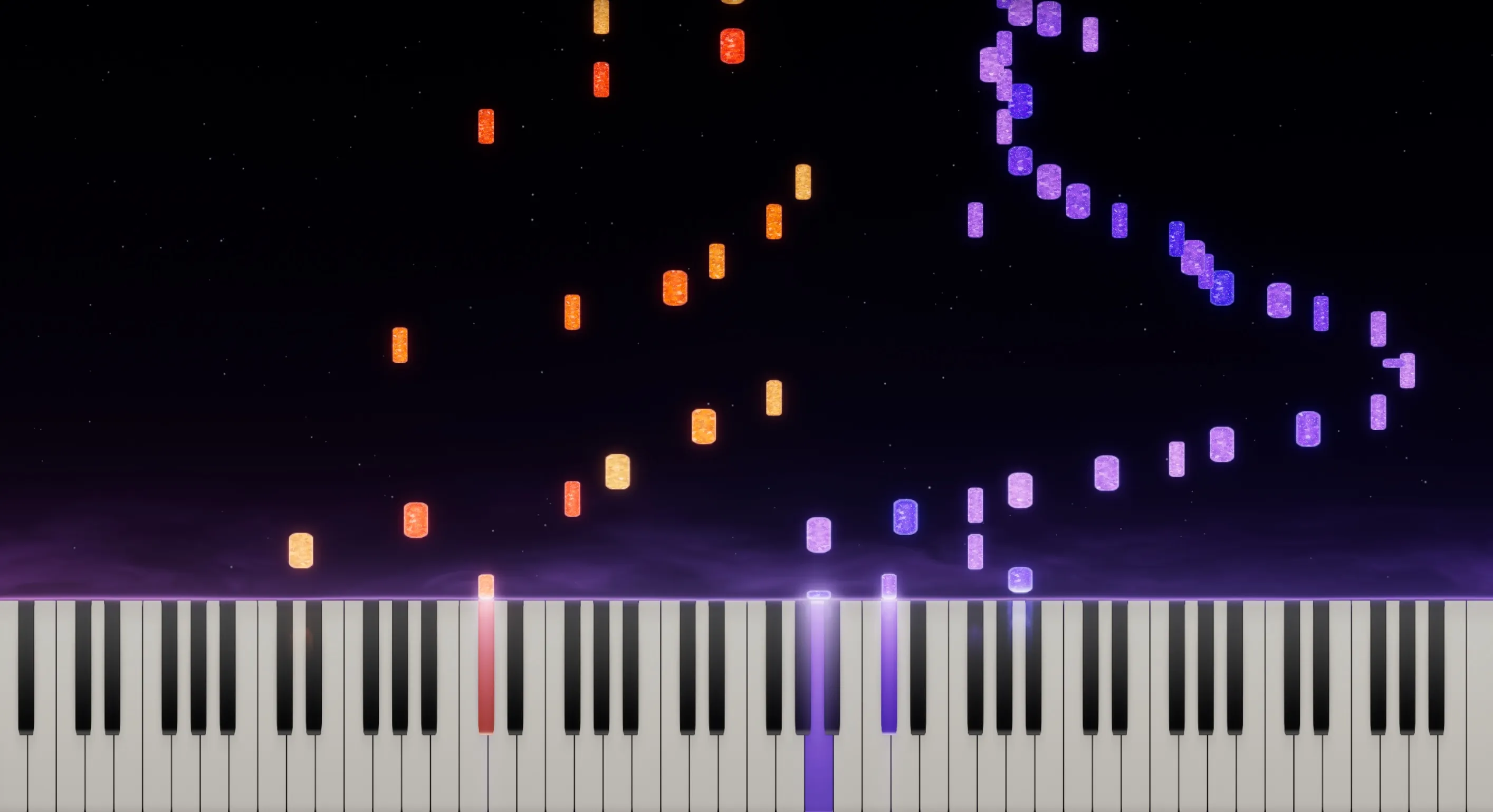
Simply Piano gets beginners started. LumaKeys is for the pieces after that.
Simply Piano is one of the most popular beginner apps: structured courses, a song library, and a microphone that listens to your playing and moves you on when you get it right. It runs on iPhone, iPad, and Android. LumaKeys is a one-time Mac app for self-taught pianists who learn from falling notes: any piece, loop and slow-down, hands split, recording, piano-roll editing, audio-to-MIDI transcription, and video export.
Short version: if you are starting from zero and want a course on your phone, Simply Piano is built for that. If you want to learn any piece you choose, keep your own versions, and pay once on a Mac, pick LumaKeys.
By Ramon, founder of LumaKeys · Facts checked
Which one fits you?
Choose Simply Piano if
You are a complete beginner and want a course that tells you what to do next.
You want it on iPhone, iPad, or Android.
You play an acoustic piano and want the app to listen through the microphone.
You are happy with a subscription.
Choose LumaKeys if
You want to learn any piece, from any MIDI or any recording.
You prefer falling notes to sheet music.
You want to record, edit, and keep your own playing.
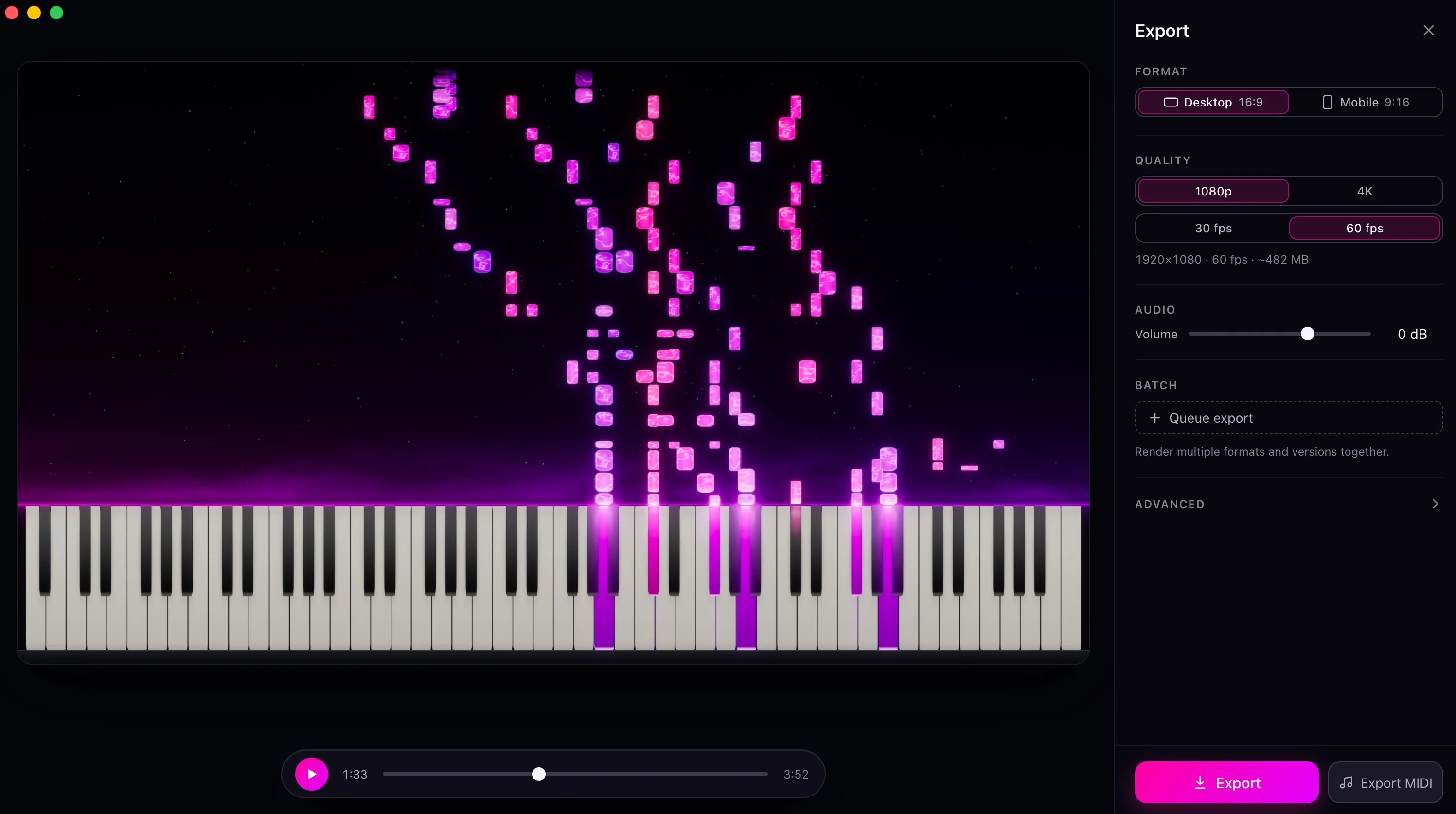
You want to export a video of your playing for social.
Any piece, not only the ones in a library. Loop, slow down, split the hands.
Audio to MIDI, on your Mac
Heard a piece you want to learn? Drop in the audio and it becomes editable notes, on your Mac.
Export a video worth posting
Your playing, in your colours, exported up to 4K for YouTube, TikTok, or Reels.
The long version.
What Simply Piano does well
Simply Piano makes the first weeks easy. The courses are clear, the app listens and reacts, and it runs on the phone that is already on the music stand. For a beginner who has never touched a piano, that is a good start.
It has a large licensed library and a lot of people have learned their first songs with it.
Where it stops
Simply Piano is a course. It teaches its library in its order, with sheet music at the centre. It does not record your playing as something you keep, it does not edit or transcribe, and it does not export a video. When you outgrow the course, the app has nothing more to offer.
It is a subscription, and the songs stay inside it.
What LumaKeys is built for
LumaKeys is for the pieces after the course. Bring in any MIDI, transcribe a piano recording on your Mac, or play it in yourself. Learn it from falling notes, record your version, fix it in the piano roll, keep it in your repertoire, and export a video in your colours.
It is Mac only and it is not a course. Free covers the full app with caps.
Ramon · Founder of LumaKeys
Why I built it
I learned piano the self-taught way: falling-note videos on YouTube, no sheet music, no teacher. Scriabin, Rachmaninoff, Chopin, one bar at a time.
Beginner apps get people to the piano, and that matters. What I could not find was the app for the years after: the pieces I chose, the versions I recorded, the videos I wanted to share.
LumaKeys is the app I wished for back then: learn a piece, record it, fix it, keep it, and turn it into a video, all in one place, paid for once.
For self-taught pianists who have moved past beginner courses and want to learn any piece, yes. For a first course on a phone, Simply Piano is the better fit.
Does LumaKeys listen through the microphone?
No. LumaKeys works with a MIDI keyboard or your computer keys. Transcription listens to recordings, not to live playing.
Does LumaKeys run on iPhone or iPad?
Not yet. LumaKeys is a Mac app, on Apple Silicon and Intel.
Is LumaKeys cheaper than Simply Piano?
Simply Piano is a subscription. LumaKeys Pro is $69 for a limited time, then $99, once, and Free never expires.