For the self-taught

Learn piano without
reading sheet music.

Can you learn piano without reading sheet music? Yes. Falling notes show you which key to press, when, and for how long — so you can learn a real piece the first time you see it, slowed down as far as you need. It's how a whole generation of self-taught pianists learned from YouTube, and it's a real method, not a workaround.

This page explains how it works, what you trade away (honestly), and a starter method from someone five years into learning exactly this way.

By Ramon · Founder of LumaKeys · Self-taught pianist Published Updated

How learning from falling notes works

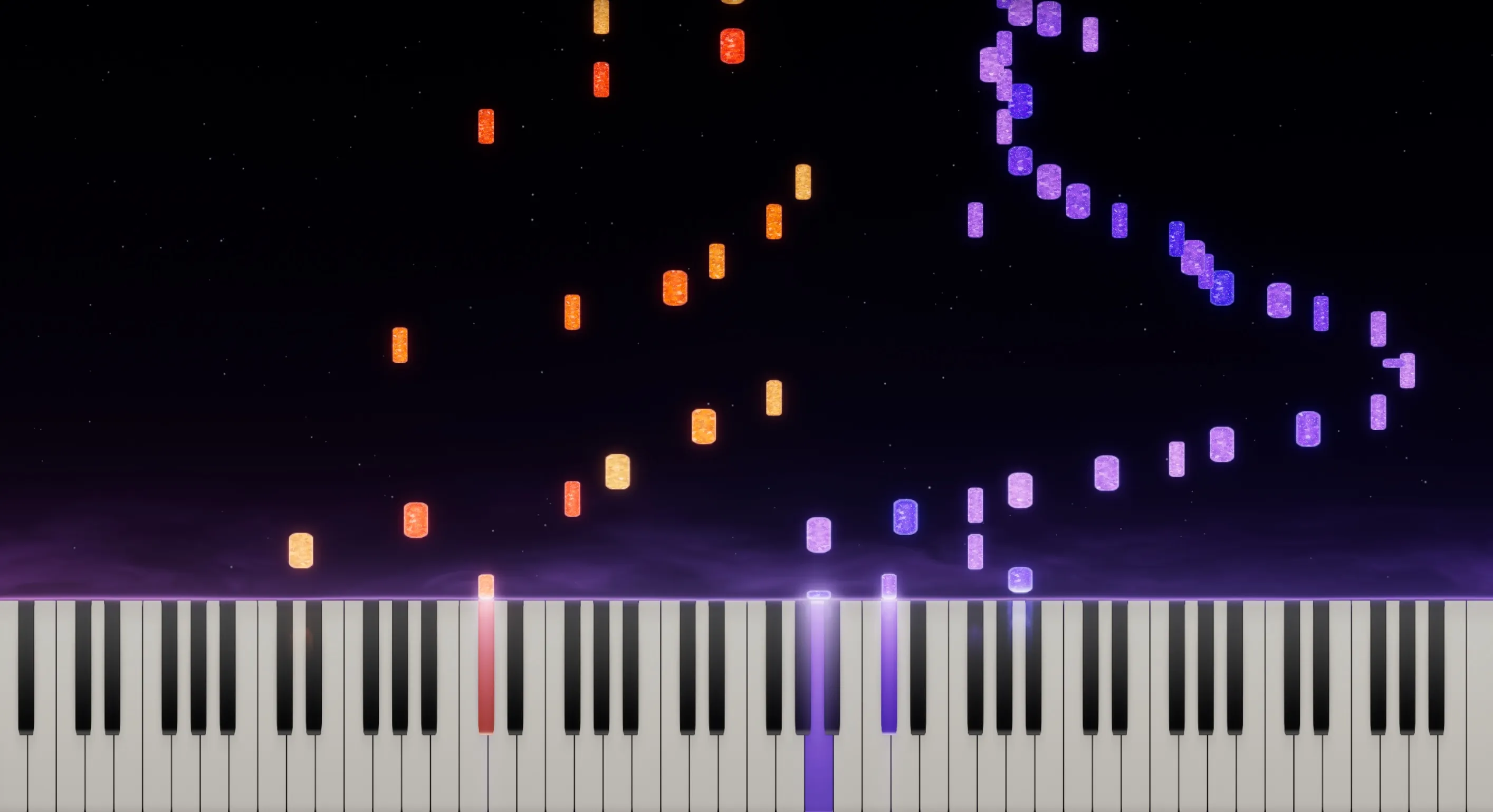
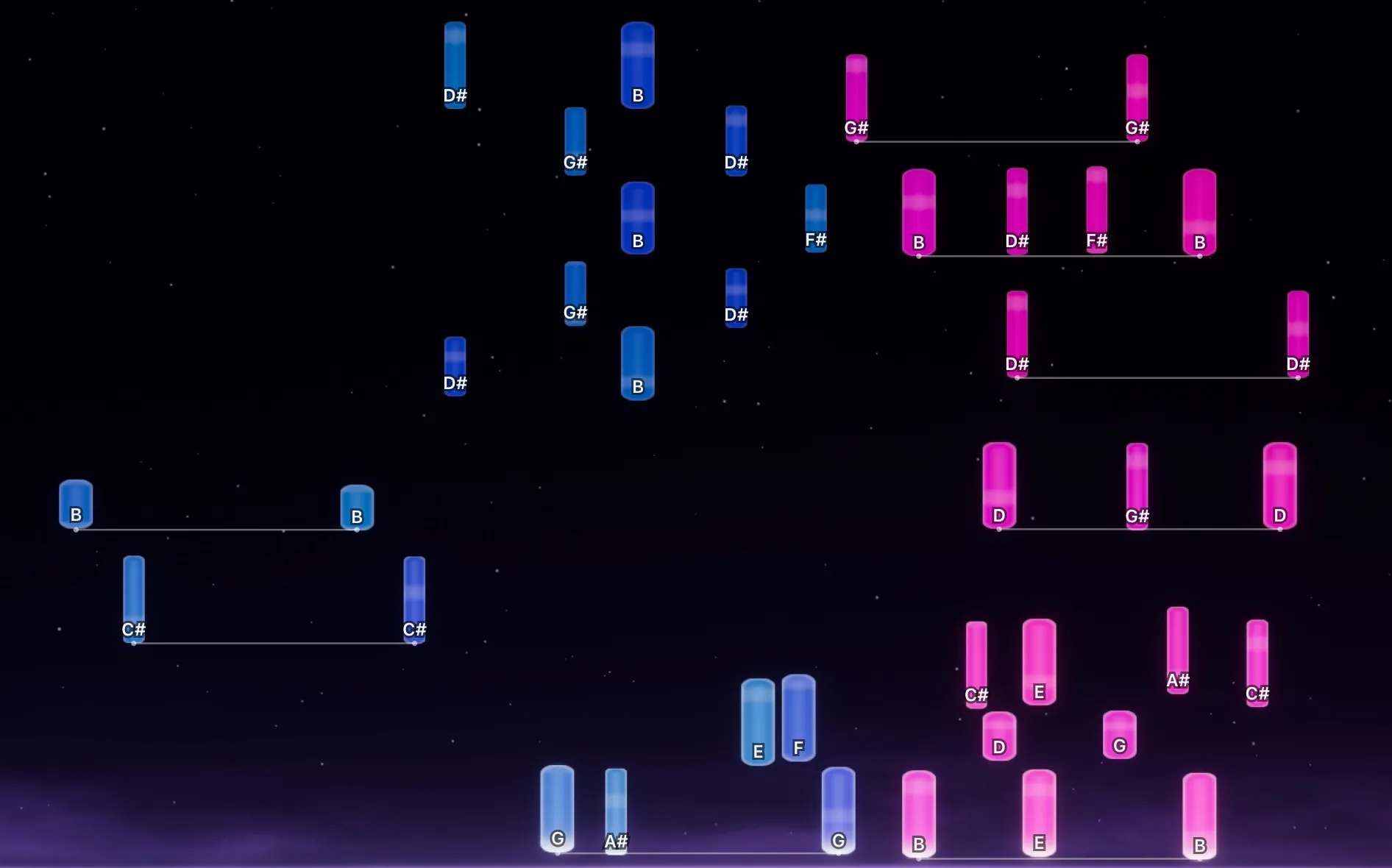
The piece scrolls toward a keyboard on screen. Each note is a bar falling toward the key it belongs to: where it lands is which key, when it lands is the timing, and its length is how long you hold. Left and right hand get their own colors, and note names sit on the keys while you still need them.

Because the notation is the keyboard itself, there's nothing to translate. You slow the piece down, loop the two bars that resist you, practice one hand at a time, and speed up as your hands learn. The same hours of practice as any method — just spent playing instead of decoding.

Falling notes in LumaKeys with note names on the keys and the octave helper visible
Note names on the keys, hand colors, octave guides — training wheels you drop when ready.

The four ways people learn without notation

Falling notes

Notes fall toward the keys; you press each key as its note arrives. You see which key, which hand, and how long to hold, with the piece slowed down as far as you need. This is how most self-taught pianists on YouTube learned.

By ear

Listen, find the notes, repeat. The slowest start and the strongest long-term skill — most people who learn visually pick up ear skills on the side without deciding to.

Chord charts

Read chord names (C, Am, F, G7) instead of individual notes and build your own accompaniment. Great for pop and songwriting; less useful for classical pieces, where the written notes are the piece.

Video tutorials

Watch hands on a keyboard and copy. It works, and it's how many people start — the limits are pause-and-rewind friction and being stuck with whatever the uploader chose to play.

The honest trade-off

Sheet music is the more efficient path if your goal is classical training: sight-reading, exams, accompanying, playing from any score ever printed. No falling-note app changes that, and this one won't pretend to.

But efficiency isn't why most people quit piano — dread is. If notation is the wall between you and the instrument, the visual path removes the wall and keeps the music. You still build technique, memory, and an ear, because those come from the hours at the keys, not from the format the notes arrived in. And the repertoire is not beginner-only: self-taught falling-note players work their way to Chopin, Scriabin, and Rachmaninoff. Slower than a conservatory student — and playing them.

Ramon at his piano

The proof, from the founder

I've never taken a piano lesson and I can't read sheet music. Five years ago I bought a piano, and everything I play — Scriabin, Rachmaninoff, Bortkiewicz, Chopin — I learned from falling notes, mostly scattered Synthesia videos on YouTube.

My method is the one on this page: pieces I love, right hand first, short sections, looped slow, left hand simplified until it catches up. It's not the officially efficient way. It's the way that kept me playing for five years, and my playing got somewhere I'm genuinely proud of.

I built LumaKeys because this way of learning is real and deserved a serious tool — one place to learn your pieces, keep them, record your own versions, and make something beautiful out of them.

Ramon · Founder of LumaKeys

A starter method that survives contact with real life

  1. 1

    Pick a piece you actually love

    Not a method-book exercise. Motivation is the scarce resource when you're self-taught, and a piece you've wanted to play for years is worth ten exercises.

  2. 2

    Start with the right hand

    The melody is what your ear knows, so it comes fastest and pays back first. Get a section of the right hand comfortable before the left hand exists at all.

  3. 3

    Work in small sections

    Thirty seconds to two minutes of music, not the whole piece. A section you can finish this week beats a piece you'll abandon this month.

  4. 4

    Loop it slow, then speed up

    Slow enough that you make almost no mistakes, looped until your hands know it without you watching them. Then raise the tempo in steps.

  5. 5

    Simplify the left hand without guilt

    If the written left hand is beyond you today, play a simpler version that keeps the harmony. The piece stays alive, your hands catch up over months, and nobody is grading you.

Hands learning a piece on a MIDI keyboard with LumaKeys falling notes on the screen behind

Where LumaKeys fits

LumaKeys is a Mac app built around exactly this method: falling notes with loop, slow-down, and hand isolation for the learning, a library that keeps every piece you're working on, and recording and video export for when a piece becomes yours. Bring in any MIDI file, or drop in a piano recording and it becomes editable falling notes.

Pro is $99 one-time, with a free tier to start. The free beta is open now, and beta testers lock the $69 founding price — pricing here, and if you're weighing it against the classic app, here's the honest comparison.

Questions & answers

Can you learn piano without reading sheet music?

Yes. Falling notes, learning by ear, chord charts, and video tutorials are all real paths, and thousands of pianists have learned this way. Falling-note visuals show you which key to press, when, and for how long, so a piece is learnable the first time you see it.

Is learning piano without sheet music cheating?

No. It's a different notation, not a shortcut — you still put in the same hours of practice, repetition, and listening. What matters is whether you can play the music you love, and how you got there doesn't show in the playing.

Will I hit a ceiling without sheet music?

You'll trade some things away: sight-reading, exams, and reading unfamiliar scores in an ensemble. For playing repertoire you choose, recording, and composing, there's no hard ceiling — self-taught players reach Chopin, Scriabin, and Rachmaninoff on falling notes. It takes longer than a teacher-led path; it still gets there.

Should I learn to read sheet music later?

If you want to, yes — it opens repertoire that has no MIDI or tutorial, and it's easier to learn once you already play. But it's an addition, not a requirement. Plenty of lifelong players never read, and play beautifully.

Do I need a MIDI keyboard to learn with falling notes?

It helps, but you don't need one on day one. In LumaKeys you can start with your computer keys and plug in a MIDI keyboard whenever you're ready.

How long does it take to learn a piece this way?

A short, simplified section of a piece you love: days to weeks of regular practice. A full romantic-era piece at tempo: months. The honest pattern is that the second piece comes much faster than the first, because your hands keep everything they learned.

Sources & proof

Sources checked 12 July 2026. This is a first-hand guide, not a claim that one learning path is right for everyone.

Join the LumaKeys beta now.

Privacy

One-time purchase · No subscription